
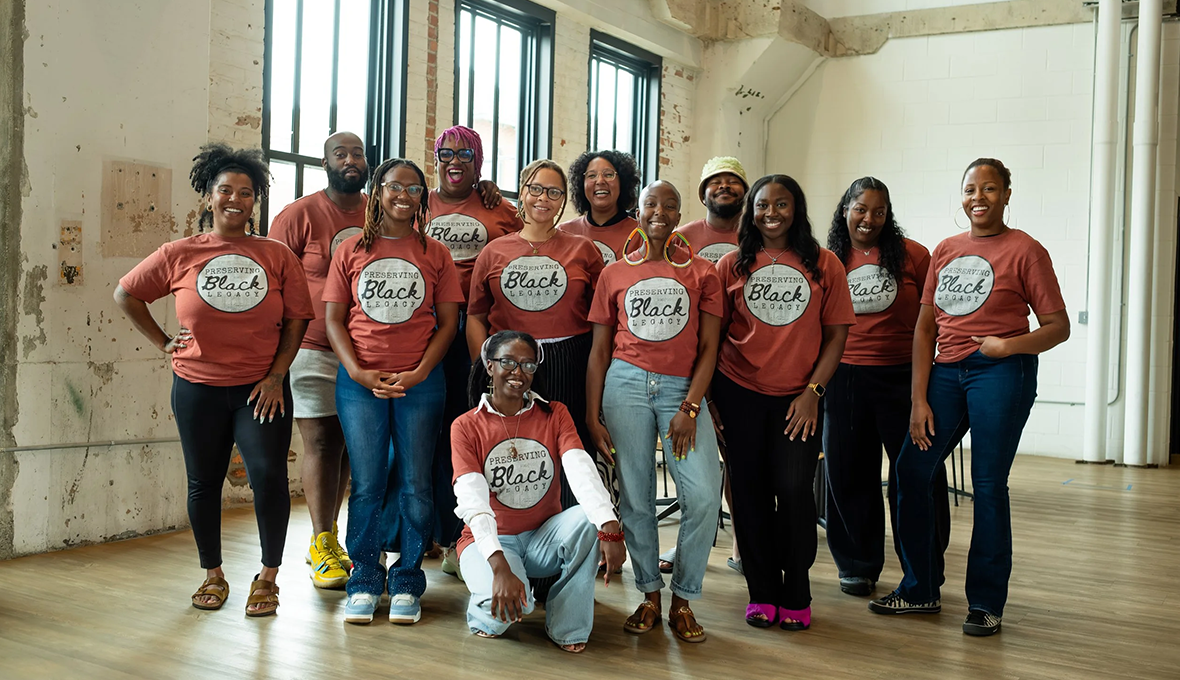

The Black Bottom Archives is a living community archive dedicated to sharing and preserving Black Detroit stories.
Founded in 2015 by young Black Detroiters P.G. Watkins and Camille Johnson, the archives amplify the voices, experiences, and perspectives of the people (and their descendants) who built lives in Black Bottom and Paradise Valley.
“We started off as a Tumblr page,” Co-executive Director Marcia Black explains, “and eventually became a digital publication that published stories that Black Detroiters wrote about a variety of topics. We had a podcast, a book club, and then in the past few years since 2019, we’ve been collecting oral histories from Black Bottom residents and descendants, and we developed a digital archive that we launched in 2020.” [1] The digital archive now includes, “oral histories collected from community members and their descendants, information about notable historical sites and figures, and digital representations of still and moving images from Black Bottom and Detroit at large.”
Why Black Bottom and Paradise Valley? “People often say that Detroit history is Black history,” Black said. “When we think about Black Bottom, I love to talk about its importance in being a key settlement place for Black people coming here during the Great Migration. It really is the foundation of Black culture in Detroit, and so it’s a story that needs to be remembered and offers a lot of lessons for how we might make a better future that can benefit Black Detroiters.” Paradise Valley, a Black business and entertainment hub, was connected to Black Bottom. As Black describes, “Often people talk about the beauty salons and the skating rinks, the churches and schools. It’s just a place that people continue to miss decades later.” [1] You can explore Black Bottom using BBA’s interactive map, which includes historic sites, panoramic street views, and a comparison of historic and contemporary maps. Reporting on BBA, Detroit writer Kahn Santori Davison describes Black Bottom:
Located near Detroit’s east side bordered by Gratiot Avenue, Brush Street, and the Detroit River, it was demolished by the city of Detroit via an urban renewal project in the late 1950s through early 1960s. It was then replaced with the Lafayette Park residential district and the (now much-contested) Interstate 375.
At its peak, there were an estimated 130,000 of residents living in Black Bottom and Paradise Valley with an estimated 300 African American-owned businesses according to a report sent to Detroit City Council on September 20, 2023 from David Whitaker, the director of the Legislative Policy Division.
The report details 10,000 structures demolished and 43,000 residents displaced with most receiving little to no relocation help. The removal of Black neighborhoods and Black-owned businesses was devastating and the memories of the communal richness of the people and the area seem more lost to history with each year that passes. [2]
Black hopes, “that folks feel inspired to know that we started off as a simple Tumblr page and have grown and expanded. This is possible. Anybody else can replicate this, and so we hope folks feel inspired to preserve their own community stories in whatever way they’d like.” [1]
Sources:
[1] “Celebrating 10 Year of Black Bottom Archives at the Detroit Historical Museum,” Fox 2 Detroit, February 24, 2025.
[2] Kahn Santori Davison, “Black Bottom Archives celebrates 10 years,” Model D, February 6, 20225.
Updated 2/25/2026