
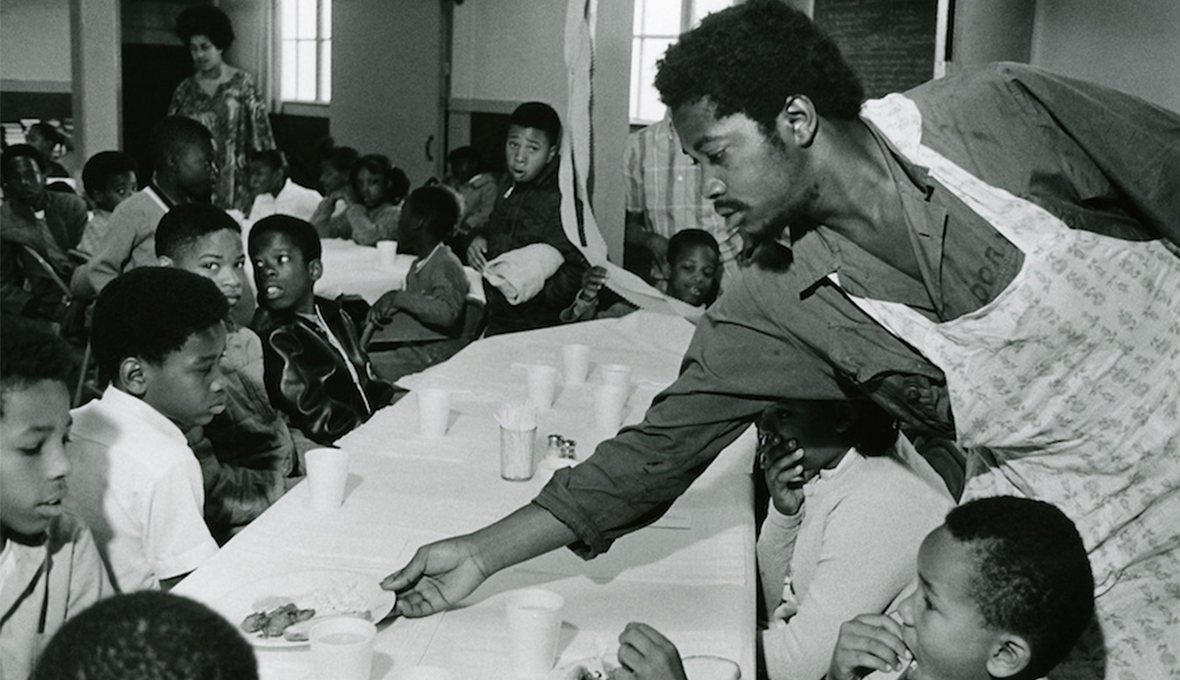
In 1969, three years after Huey Newton and Bobby Seale founded the Black Panther Party for Self Defense, the Panthers launched into community services, including the highly successful Free Breakfast Program for Children.
The Child Nutrition Act of 1966 established the federal School Breakfast Program because, as President Lyndon B. Johnson then remarked, “good nutrition is essential to good learning.” (It is also essential to soldiering: The National School Lunch act passed on June 4, 1946 as, “a measure of national security,” spurred, in part, by the high numbers of American men rejected for World War II due to diet-related health problems.) The Black Panthers, fighting a different war, the war on poverty, decided to take action where the government and schools continued to fall short.
Billy “Che” Brooke, deputy minister of education for the Black Panther Party of Chicago, said of the program initiation: “Research had been done and it was determined the young students would learn more proficiently if they had nutrition in them. A lot of our young kids at that particular time went to school hungry. There was absolutely no programs that would allow children to eat once they got to school.”
The first Panther Free Breakfast Program began at St. Augustine’s Church in Oakland, California with the support of Father Earl Neil, parishioner Ruth Beckford-Smith, and neighborhood parents. By 1971, dozens of cities had a Free Breakfast Program, feeding tens of thousands of children nationally. In a 1969 U.S. Senate hearing, the federal school lunch program administrator Rodney E. Leonard admitted the Panthers probably fed more poor school children than the state of California. “I don’t think [the government] wanted to be outdone by a community-based organization, especially the Panthers,” Panther Party member Norma Armour Mtume said. “I really think we were very instrumental in school food programming.”
In his book “Black Against Empire: The History and Politics of the Black Panther Party,” Joshua Bloom reports that foodstuffs like grits, eggs, toast, and milk were donated by local businesses, as allies across the country pitched in to make breakfast. Some businesses who weren’t Panther allies were strong-armed into cooperating anyway.
The attention the Panthers efforts brought to hungry schoolchildren and the popular support of the program marked a turning point in bringing attention to the importance of breakfast programs, and lobbying by mainstream women’s organizations would cement dramatic increases in funding of the National School Lunch Program by Congress, and the authorization to expand the National School Breakfast Program to all public schools in 1975.
On the first day of the program, 11 school children gathered around a table at St. Augustine’s for a breakfast of grits, fruit, toast, eggs, and milk. By the end of the week, there were 135 children there for breakfast. Interviewed for the Annals of the Association of American Geographers in 2009, parishoner Beckford-Smith shared that "the school principal came down and told us how different the children were. They weren’t falling asleep in class, they weren’t crying with stomach cramps."
J. Edgar Hoover, then Director of the Federal Bureau of Investigation (FBI), seeing the success of the program and its popularity with moderate community members, wrote in a 1969 memo that: “One of our primary aims in counterintelligence as it concerns the [Black Panther Party] is to keep this group isolated from the moderate black and white community which may support it. This is most emphatically pointed out in their Breakfast for Children Program, where they are actively soliciting and receiving support from uninformed whites and moderate blacks.” [1]
In the cast of the program in Chicago, Brooks recalls that, “as far as the city of Chicago was concerned the breakfast program was probably one of the most horrific programs that they had ever seen. That year, they arrested party members who were out collecting donations. They raided our office in May of ‘69, they came back again in June of ‘69 and raided the office again.
They destroyed all our donations. They wanted to portray us as something other than what we were. We were able to pull it off basically by enlisting community support.” [2] The Chicago program served more than 400 children every morning.
The Seattle Civil Rights and Labor History Project reports that Seattle’s then disbanded Black Panther Party chapter continued to operate what might have been the last standing free breakfast program until 1976.
Sources:
[1] For example, the Seattle Civil Rights Labor History Project reports that the Seattle Panthers presented a local Safeway grocery store with a demand for $100 weekly donations to their breakfast program, and staged demonstrations outside the store when no donations wer forthcoming. Panther Elmer Dixon recalled the challenge saying, “that the Seattle Panthers had concluded that Safeway was profiting handsomely due to the patronage of Central Area customers. In return the company should therefore donate eggs and sausage for children’s breakfasts.” Kurt Schaefer, “The Black Panther Party in Seattle,” Seattle Civil Rights and Labor Project, 2005.
“History of School Lunch,” Illinois School Nutrition Assoication, 2025.
Katherine Newman, “Black Panthers Connected Nutrition To Education Long Before Serving Breakfast in Schools Became Popular,” Citizen Weekly, February 14, 2018.
Senate Select Committee, Part 11, July 9-11, 196, 3478.
Arielle Milkman, “The Radical Origins of Free Breakfast for Children,” Eater, February 16, 2016.
Diane Pien, “Black Panther Party’s Free Breakfast Program (1969-1980),” Black Past, February 11, 2020.
Matt Harvey, “Food drives around Chicago continue a tradition of revolutionaries feeding the community,” The Tribe, June 17, 2020.
Che Brooks, John Harris, and Leiana Carrasco-Ramon, “The People’s Free Food Program,” Mapped, January 2023.
“Seattle Black Panther Party History and Memory Project: Elmer Dixon Interview,” Seattle Civil Rights and Pabor Project, Interviewed May 17, 2005 by Janet Jones and Trevor Griffey.
Updated 05/21/2026