

 podcast: Episode 3 - The Friendly Fridge with Selma Raven and Sara Allen
In Our Hearts is an action-oriented mutual aid group. Its purpose is not to exist as an organization but to facilitate the interaction of collectives, affinity groups, and projects involved with the network, helping to coordinate actions and projects on a larger scale as well as creating space for social interaction and face-to-face conversation. In Our Hearts provides a way for people to plug into existing open collectives and communities, find like-minded people to start new projects, or even bring their existing projects into the network.
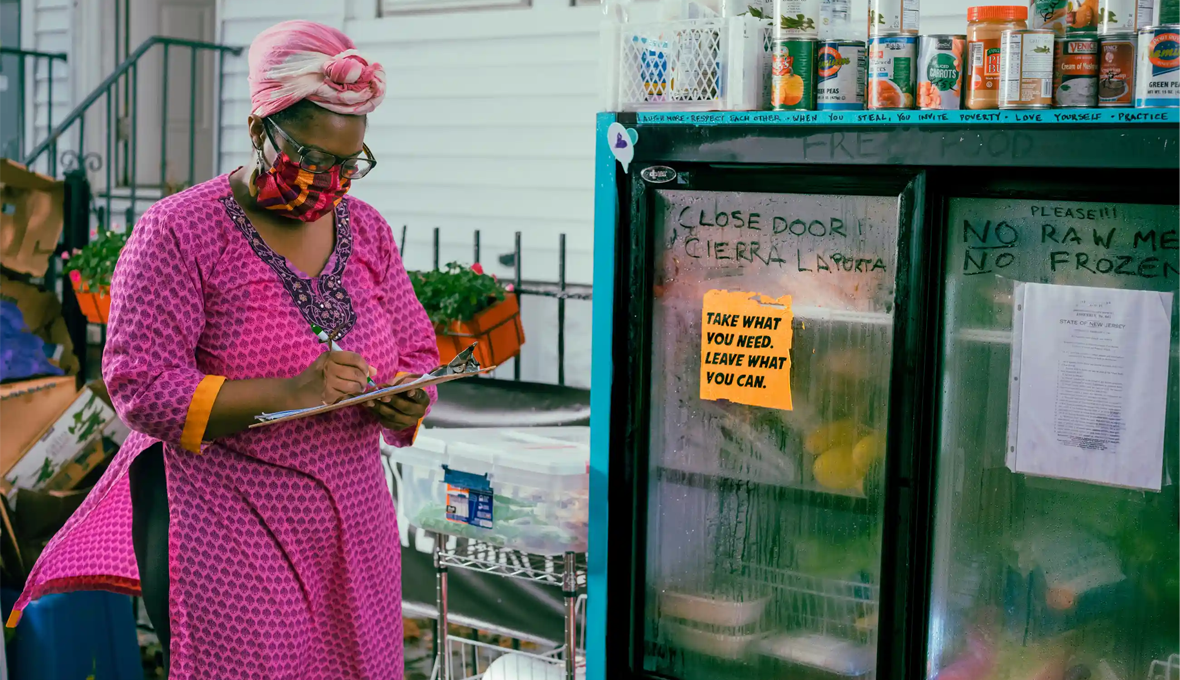
In May, two months after Marianne Pita recovered from Covid-19, she heard about a fridge set up on a street corner not far from her house in the Bronx. Neighbors and local businesses could donate food – homemade, store-bought, or leftover from a day’s sales – and anyone who needed food could take some. The fridge helps feed people in the middle of a pandemic and mass unemployment – in a year where as many as 54 million Americans could need food aid.
“There are no strings attached and no questions asked,” says Pita. “Mutual aid means something different than the way welfare works, where you’re being quizzed [on your need] because you have to qualify for the aid. You have to be really, really [good],” explains Pita, who volunteers, delivering food to local fridges. “And that’s not what we’re saying.”
At least 15 other community fridges have been set up in the five New York boroughs and New Jersey. Los Angeles and Oakland both have networks of community fridges up and running, and grassroots efforts to start community fridges in Houston, Minneapolis, San Francisco, and Miami are taking off. The idea of community fridges – and more broadly, of free food for all who need it – has been around for decades. More than 50 years ago, the Black Panther Party distributed free breakfast to children out of a local church in the Bronx; a radical program for its time that paved the way for the US government to follow suit in 1975.
Today “there are so many people that are involved as fridge-keepers,” says Adela Wagner, 30, who helps with a community fridge in the Crown Heights neighborhood in Brooklyn. They range from those who donate food – bakeries, community gardens, farmers' markets, and more – to neighbors who keep an eye on it throughout the day. “Most of them are not given credit,” Wagner says.
Source:
Frida Graza, 'No one should go hungry': street fridges of free food help Americans survive Covid pandemic, The Guardian, August 10, 2020.
