
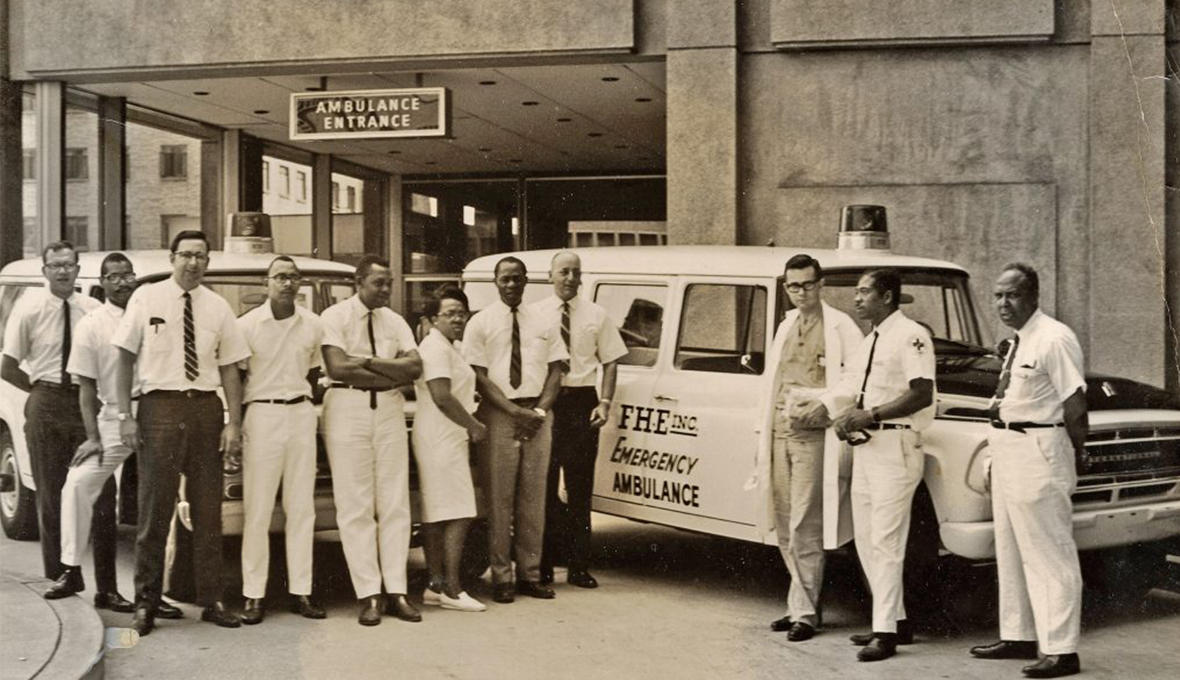
The Freedom House Ambulance Service operated from 1967 to 1975, pioneering emergency medical services in Pittsburgh’s predominately Black Hill District.
Led by Dr. Peter Safar and Dr. Nancy Caroline, Freedom House set the national standard for modern Emergency Medical Services (EMS). It was the first U.S. organization to train and employ paramedics to provide advanced life support before hospital arrival. Before the existence of 9-1-1 and ambulances, Freedom House volunteers were the most highly trained field practitioners of emergency medicine in the country. Staffed primarily by working-class men and women, most of them Black, Freedom House paramedics performed lifesaving treatment, including CPR and administering IVs, intubation, and defibrillation. Campbell Robertson writes in the New York Times that, “A 1966 government study reported that the chances of survival for someone who was seriously wounded were greater in a combat zone of Vietnam ‘than on the average city street.’” The Freedom House Ambulance Service aimed to change that.
In the Hill District, a local Philanthropy called the Falk Foundation, seized on the opportunity provided by federal anti-poverty money to start a local team of medics operating out of a neighborhood non-profit called Freedom House. For training, Falk Foundation president Philip Hallen enlisted Dr. Peter Safar, the developer of CPR and a Pittsburgh anesthesiologist, and Dr. Nancy Caroline, who developed the paramedic curriculum and served as the first Freedom House medical director in 1974. The first class consisted of 25 Black men who trained for 32 weeks, completing 300 hours of hospital-based instruction, nine months of supervised field internships, and learning anatomy, physiology, disease recognition and diagnoses, and how to perform advanced first aid and emergency medical care. An EMS1 article published in 2014 described the recruits: “Most were unemployed. Some were returning Vietnam war vets struggling with drugs and alcohol. Some were recruited off the streets.” Alongside the coursework, many trainees pursued GEDs and received life skills training. Previously labeled “unemployable,” many Freedom House medics went on to pursue advanced degrees, advanced training in medicine, and state-level leadership and administrative roles.
“One of the really pressing needs was transportation,” Hallen said. “People simply couldn’t get to hospitals.” As part of their curriculum, Freedom House medics even studied defensive driving. In their first year, the ambulance service operated two ambulances and responded to nearly 6,000 calls, saving over 200 lives, with an average response time of less than ten minutes. Dr. Safar even went so as far as to improve ambulance design. Still, fire and police departments vigorously opposed the ambulance service, which they saw as a threat to their autonomy.
“I know what it’s like,” Freedom House medic John Moon said. “When I looked at those patients, I could feel for them.”
Over the course of its eight-year existence, Freedom House responded many additional thousands of calls, including calls they followed themselves on the local police scanner. They provided 24-hour emergency medical care and hospital transport in two districts. “Even as Freedom House struggled with funding and mistrust from local officials, it soon became known that Black residents in the poorest parts of Pittsburgh were getting the best trauma care in the city,” Robertson writes. “In 1975, the mayor, Peter Flaherty, never a supporter of the program, created the Pittsburgh EMS and defunded Freedom House.”
“We did something no one thought we could,” Moon said. “To have jumped those barriers, proved everyone wrong? Nobody could take away what we did or the pride we had.”
Similar Projects:
Ujimaa Medics, Chicago Street Medicine, Care-Based Safety
Sources:
[1] Campbell Robertson, “Ambulance EMTs Are Routine Today. These Black Medica Helped Pave the Way,” New York Times, February 20, 2026.
[1] EMS 1 & NEMSA, “How Pittsburgh’s ‘Freedom House’ shaped modern EMS systems,” EMS1, February 2, 2026.
[3] Heinz History Center, “The History and Legacy of the Freedom House,” February 21, 2022.
[4] Matthew L. Edwards, M.D., “Race, Policing, and History — Remembering the Freedom House Ambulance Service,” The New England Journal of Medicine, April 10, 2021.
[5] Daphne Sashin, “All-black ambulance service inspired today’s EMS system,” Stanford Medicine, February 12, 2020.
[6] Kevin Hazzard, “The First Responders,” The Atavist Magazine, 2019.
Updated 05/21/2026