
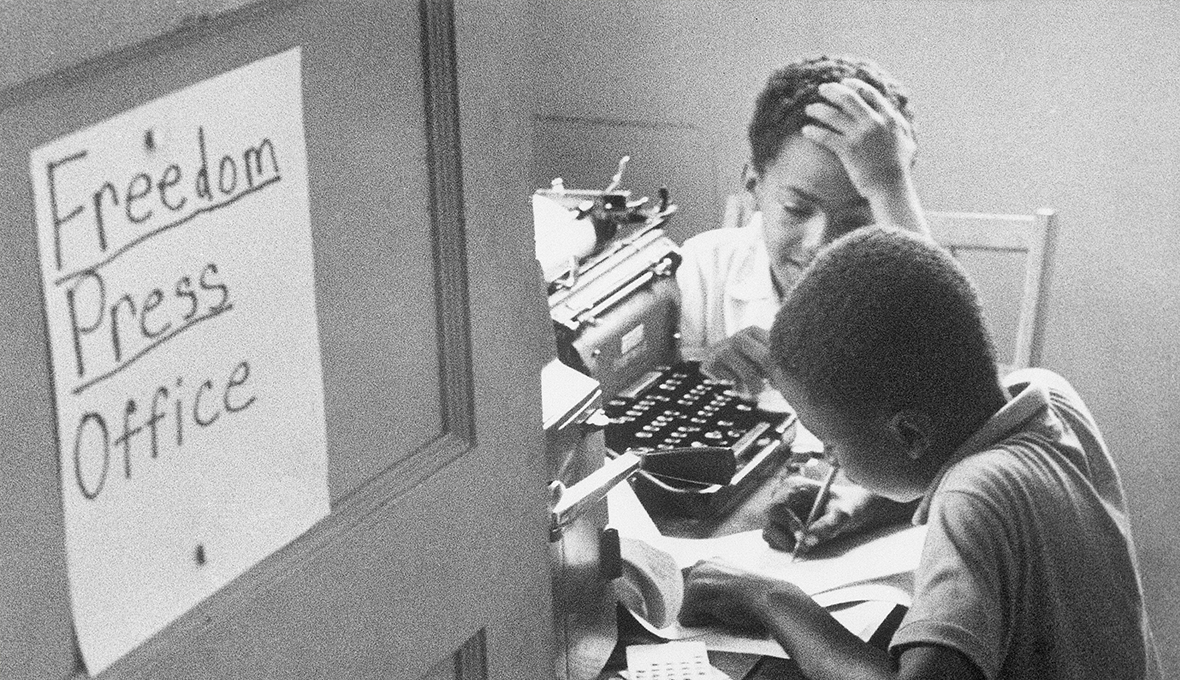
Freedom Summer was launched by civil rights activists to register as many African American voters as possible in Mississippi, a bastion of white power, and the state with the lowest percentage of African Americans registered to vote in the country. (From slavery through the era of Jim Crow, Mississippi legally disenfranchised nearly half of its total population.) While Black people made up one third of the state population, only 6.7% were eligible to vote in 1964. (Where civil rights icon Fannie Lou Hamer lived near Ruleville, 52.4% of the adult population were Black and yet only 2.97% were permitted to register to vote.)
Charlie Cobb, the Student Nonviolent Coordinating Committee (SNCC) field secretary who conceived of the idea of the Freedom School campaign, pointed out the distinct opportunity of organizing young people not yet able to vote, enrolled in the workforce, or attending college: many of them remained in Mississippi, at least until the end of high school, creating the potential for a stable, long-term network of activists. The Freedom School organizers, volunteer teachers, and students made up a major link in the chain of grassroots educational programs that trained a generation of activists that fueled the struggles that emerged in the late 1960s — like the black power, antiwar, and women’s liberation movements.
“The Freedom Schools shaped my future, my thinking, my outlook on life, they challenged me to do the things I’ve done and to have the mindset I have. If I had to attribute anything to my community involvement, I would attribute it to me attending the Freedom School.” – Eddie James Carthan, 14-year-old Freedom School Student in Mileston, Mississippi
In his book “The Freedom Schools: Student Activists in the Mississippi Civil Rights Movement,” Jon Hale writes that, “A history of the Freedom Schools reveals that young people still in middle and high school were on the front lines of the civil rights movement, and in many instances it was the young people—not the rebellious college students or established National Association for the Advancement of Colored People (NAACP) card-carrying members—who inspired local movements in their own community. A study of the Freedom Schools illustrates how central education was to the local grassroots civil rights movement.” Not only that, but like many community-based organizing projects, the Freedom Schools brought attention to and put pressure on state and local initiatives to improve gaps in their own systems. (Head Start, a federally funded early-childhood program that sought to alleviate poverty, was implemented across the Mississippi in 1965.)
During the ten weeks of Freedom Summer, thousands of Black Mississippians were joined by over 1,000 out-of-state volunteers. SNCC’s organizing committee (including Bob Moses, the field secretary and architect of the campaign) agreed to recruit only one hundred white students for the project in December 1963, but Jewish civil rights leaders such as Allard Lowenstein went on and recruited a much larger number of highly educated white youth, mostly from the Northeast. The numbers, it turned out, would be helpful.
Like the participatory education model for the Highlander Center in Tennessee — where many SNCC members trained — the Freedom Schools operated under the conviction that oppressed people learn by being brought together and addressing their own problems. The state of education in Mississippi was dire. The poorest state in the nation in 1964, the average expenditure per pupil for a student in Mississippi was $21.77 for Black children and $81.86 for white children. The Freedom Schools offered something different — a relatively novel student-centered curriculum that included Black history, social critique, and organizing strategies. The act of both teaching and learning are inherently political, and never was that more apparent than at the Freedom Schools, where much of the curriculum was posed as questions.
As a part of the larger campaign, 41 Freedom Schools were set up with little-to-no-money in church sanctuaries and basements, on porches, storefronts, and under the trees of Mississippi. They were staffed by 280 Freedom Summer volunteers and attended by more than 3,000 K-12 students, with many younger and older pupils stopping by. (Cobb’s initial proposal was for a summer school for 100-200 eleventh and twelfth graders, which was then revised to twenty schools and 1,000 students.) Many of the young students marched on picket lines, organized boycotts, and desegregated community spaces for the first time that summer. In a short time, many grew to be agents of change in their home communities.
Sources:
Jon Hale, "The Freedom Schools: Student Activists in the Mississippi Civil Rights Movement," Columbia University Press, November 2018.
Updated 09/21/2026