
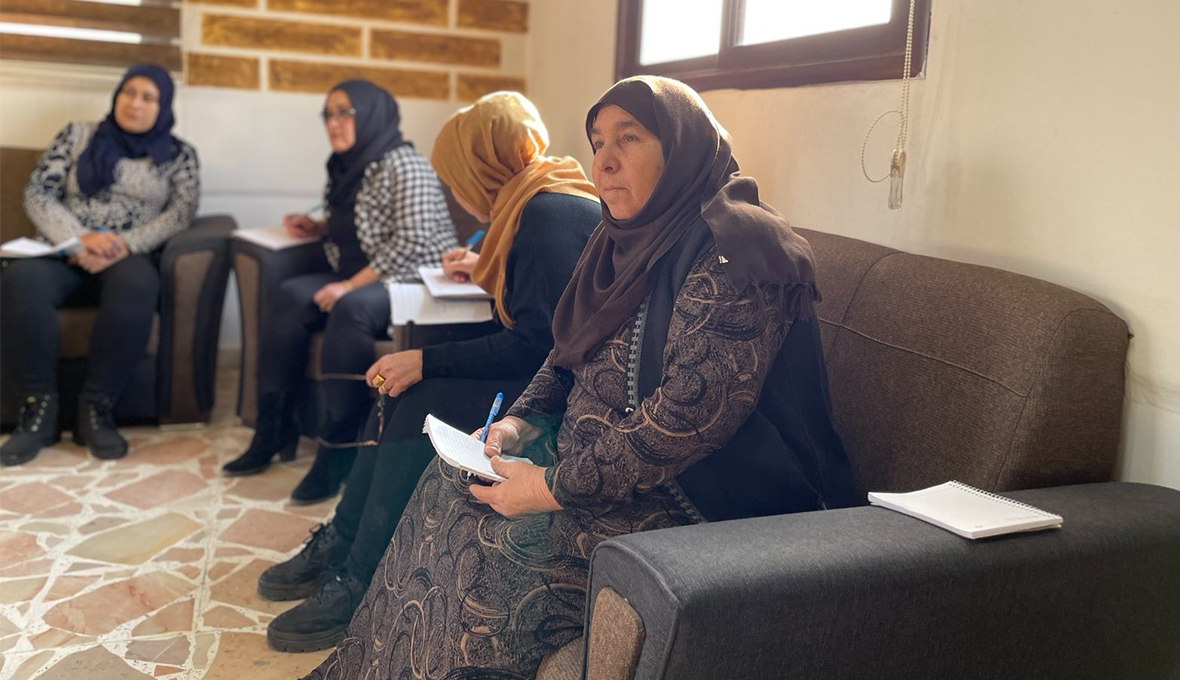

The first Mala Jin officially opened on March 20, 2011 in the now autonomous territory of Rojava in Northern and Eastern parts of Syria. More than a decade later, there are over 60 Mala Jin (“women’s houses”), where women solve disputes at the community level, often avoiding courts or police, by offering reconciliation and mediation processes for domestic and family situations.
In the 2023 article, "Rojava’s Women-Led Restorative Justice System Centers Mediation, Not Retribution," Ella Fassler describes her visit to a Mala Jin for Truthout: “These women’s houses were spaces set up by women to offer support and protection to those facing family violence and civil disputes. The manager here, Bahiya Mourad,* is a woman in her sixties with an ever-ready smile. ‘The first Mala Jin were set up in 2011,’ she says, ‘when the regime still governed here in Qamishli [also known as Qamişlo]. One day the regime came to the centre and said, you have to close down. We took sticks and kicked them out.’ They tell me that 10 years ago they helped one or two women a month; now that is up to 100.”
Today, the Mala Jin are part of the Democratic Autonomous Administration of North and East Syria (DAANES), a territory commonly referred to as Rojava, that operates as a decentralized, non-state network based on the political philosophy of Democratic Confederalism. Self-described as a “revolutionary social experiment,” the movement was inspired by the prison writing of the founding leader of the Kurdistan Workers’ Party, Abdullah Öcalan, whose radically egalitarian philosophy centers women’s liberation as a foundational pillar of society.
Kongra Star, the congress of the Kurdish women’s movement, describes Mala Jin as “a social and civil institution working for greater awareness, that aims at spreading the philosophy of social justice, the democratic family structure, and the communal life, and to combat the inhuman practices against women and children and solve the problems of women and families.”
When new members join the Mala Jin, they take a two-month long education course to develop their understanding and critical thinking skills around political and social knowledge on topics such as ideology, society, law, politics, gender relations and more. Once they finish their education, every new member works under the supervision of a more experienced member to ensure they can handle the work. Once in the Mala Jin, new members rotate into a new position every six months to one year in order to learn, develop knowledge of the Mala Jin system, and take to the work that best suits them. Most Mala Jin organize ongoing education for their members on various subjects, every two weeks.
Founding member Mourad describes their primary function, community mediation processes: “When a woman faces a problem, first, we sit down separately with the wife and discuss with her and then with the husband. Then, we gather them together to discuss their views, understand one another and come to a common understanding. Our aim is to solve problems through dialogue, without resorting to the courts. When we cannot solve a case, we refer it to the Court of Justice. But often, they send the case back to us because we are more capable of bringing about reconciliation and consensus.”
“The women who come to us have nothing, just hungry babies in their arms. We are happy to sit and discuss with them for three hours. We don’t approach them with any force – just as women, as we have learned to discuss matters as mothers. We hear both sides, advise and try to find a solution,” expounds co-founder Ilham Omer.
“Our political organizing among local women has been going on for years, but in secret. I became deaf in my right ear following a beating at the hands of the regime in 1988. They didn’t accept that women were organizing autonomously. When we began to work openly, on March 20, 2011, we were both excited and afraid because we knew of the difficulties that we would face. We were thinking about how to set women free and permit them to live on an equal basis in their family and their neighborhood and how to help women know themselves better and to organize themselves politically within their society. At that time, we were the only three members, and so we encountered many obstacles. We often sat and discussed how we could come to be accepted by our society.”
Now, Mala Jin workers receive a very modest salary. They work with the Women’s Justice Councils across the autonomous and civil administration of the region with different committees that include:
- The Social Reconciliation committee, specialized in solving disputes;
- The Education committee that organizes education courses for women at the commune level, as well seminars and lectures regarding women’s rights;
- The Media and Archive committee that documents and archives all the activities of the Mala Jin, drafts reports, and disseminates decisions and news regarding women in the justice system; and
- The Women Social Solidarity committee that conducts follows up with women who’ve sought services, as well as outreach to other women in the commune. They provide social care for divorced women and people with special needs.
*Mala Jin co-founder Bahiya Mourad's name is also spelled Behiya Murad in English.
Sources:
Dilar Dirik, "Unbowed," New Internationalist," June 23, 2020.
Elizabeth Flock, "Inside the Feminist Revolution in Northern Syria," Noēma, March 25, 2024.
Ella Fassler, "Rojava’s Women-Led Restorative Justice System Centers Mediation, Not Retribution," Truthout, October 20, 2023.
Natasha Walker, "Woman, life, freedom’: the Syrian feminists who forged a new world in a land of war," The Guardian, February 9, 2025.
Nazan Üstündağ, "A View From Beyond the State," Interrupting Criminalization, 2023.
Rojava Information Center, "Building Peace: North and East Syria's Women's Houses," SUR 30, v.17, n.30, 51 - 58, 2020.
Ronahî Nûda, "Mala Jin becomes symbol of women’s revolution," Jinha Women’s News, Compiled from posts published July 6-9, 2022.
"Mala Jin: Empowering Women, Strengthening Society," Kongra Star, January 2021.
“Mala Jin: The unique women’s houses transforming Middle Eastern society," Medya News, November 20, 2024.
Updated 06/26/2026